
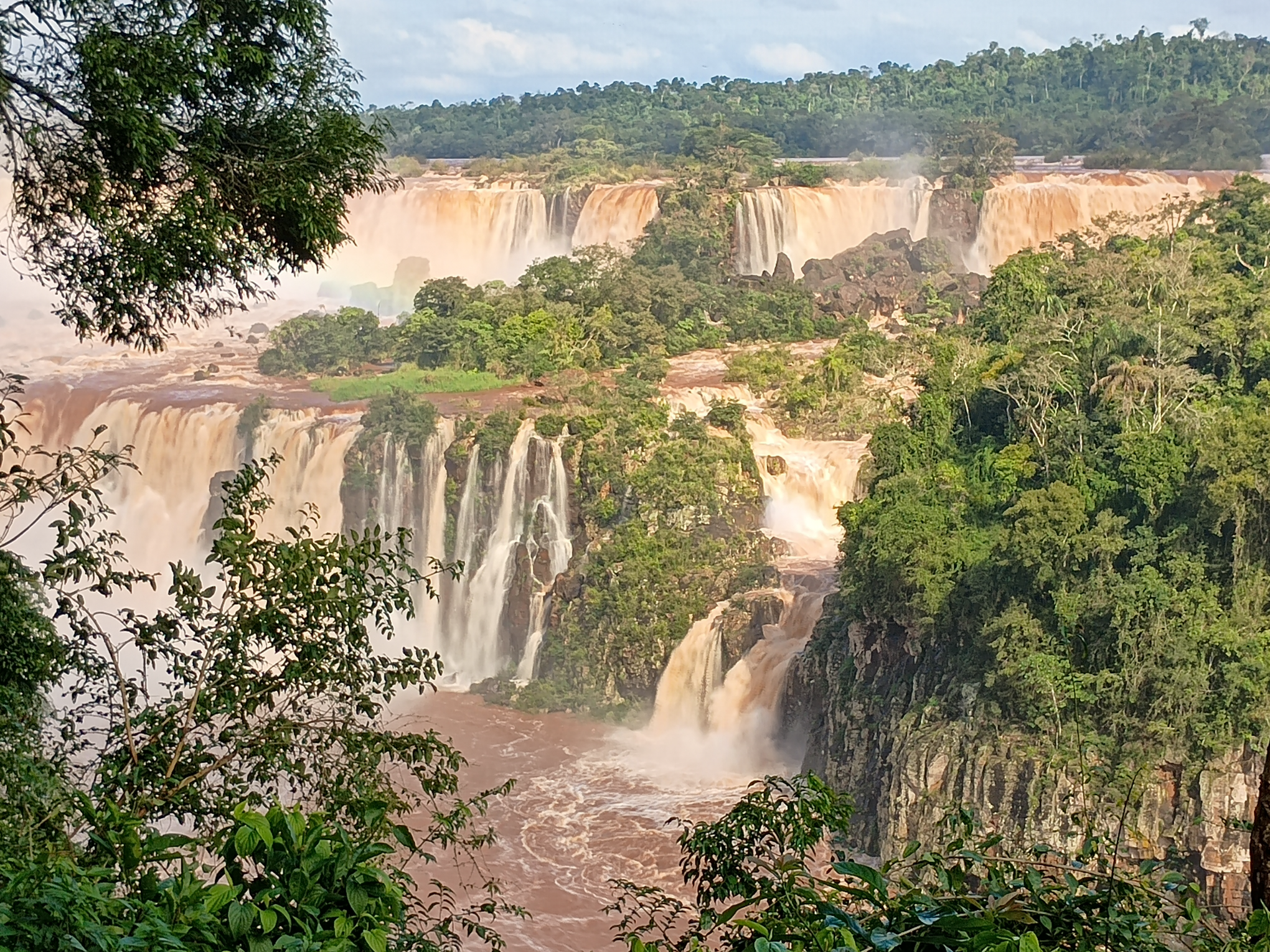
We left Rio quite early in the morning to catch a flight to Iguazu Falls. Iguazu Falls is similar to Niagara Falls in that it is a bit horseshoe shaped, but the horseshoe is quite narrow and the Falls run a much wider distance. They are actually about twice as wide as Niagara Falls. Also similar to Niagara Falls, Iguazu Falls is made up of more than a single falls. However, rather than the three waterfalls that make up Niagara Falls, Iguazu Falls has more than 250! Iguazu is also much taller.

Another cool similarity between these two falls is that Iguazu Falls sits on the border of two countries – in this case, Brazil and Argentina. The majority of the falls are on the Argentinian side, but the majority of the river (Iguazu River) that feeds the falls is in Brazil. Our flight put us on the Brazilian side of Iguazu Falls. The views across were incredible and I found myself feeling a bit traitorous to Lelawala (our Iroquois Niagara legend) because I was so enamoured by the view. To see so many separate waterfalls all in one place, separated by lush greenery is beyond impressive!


Here is a video Rob took to try to show just how wide and large the falls actually were. He still only managed to capture a small section but it does give at least some sense of the actual size.
You’ve probably noticed how brown the water is. While the falls apparently always has a bit of a reddish-brownish tinge due the red soil in the river and surrounding areas, the area had experienced a massive amount of rain in the days prior to our visit, so the run-off made the water a bit more muddy looking than normal. It also tremendously increased the amount of water flowing over the brink. We were told that the normal flow of water was 1 million litres per second, but it was 5 million litres per second while we were there. Here is a little video Rob took:
The sunshine and blue skies you see in the video above were a bit fleeting that day. We had a few small showers in the time that we were there, though they were hardly noticeable with all the mist. The best part of sun peeking in and out were the rainbows. They were absolutely everywhere and no matter how many I saw, I still felt excited.


After an hour or two of taking in the falls, we made time for some lunch at the restaurant just above the brink of the main falls on the Brazilian side. While it sounds like a similar set-up to Niagara Falls, it was actually quite a different experience. The restaurant is open air for one, on level with the river, and much, much, closer than Table Rock would be. Rob set his beer on the ledge and took a picture to try to show just how close we were sitting.


After a few final hours in Brazil, it was time to head to Argentina. For the first and only time during our trek through South America, we crossed the border by car. It was a bit of an interesting experience. First, we had to park the car and go into a customs booth on the Brazilian side to show our paperwork and essentially get approval to leave the country. We then got back in the car and waited in line to show our passports to the customs agent in the booth, much like crossing the Canada-United States border. After gaining approval to enter Argentina, we had to answer an additional question or two by a random person sitting on the stool about five feet on the other side of the booth. So strange! Fortunately, we had a driver navigating us through the whole process, which only took an hour or so in total. Unfortunately, crossing the border by car meant we didn’t end up with a stamp for Argentina in our passports 🙁 The good news is; it only took an hour because it was winter. In the summer season it can take up to 4 hours to cross.
Another similarity to Niagara Falls, is that Iguazu Falls is also the name of the town on each side of the border, so when we crossed into Argentina, we were still in Iguazu Falls, just the Argentinian versus Brazilian town. It was actually a really cool little town and I imagine in summer when there are more tourists, it’s quite a happening place. The streets are lined with all kinds of markets which seemed to mostly sell olive oil, olives, and cheese. There were also tons of restaurants and bars with the smell of charcoal BBQ in the air. The main street closes to road traffic at about 5pm which was really nice.


The next day we headed back out to the Falls. Through the night and very early morning, it rained absolute buckets but fortunately, it slowed down a bit by the time we had to head out. This was actually the only day of rain we had across our trip, and while it would have been nice to do all the hiking we did in sunshine, we would have been getting wet from the mist anyway, so it was a pretty perfect day to rain! Rob popped into the gift shop to get us the classic plastic poncho. We always laughed at the tourists in Niagara Falls wearing them all day after riding the maid of the mist. It was great for keeping our bags and cameras dry though.

Seeing Iguazu Falls from the Argentinian side is a completely different experience. For starters, it is a full day adventure with tons of walking. Each of the different trails and walkways gives you different views of different sections of the falls, and many of them bring you super close. Here’s an example:


As were walking through the national park, many of the walkways were directly over the water. Our guide told us that had it rained anymore, they would have closed many of the walkways in the park because the water would have been flowing over them. I wasn’t sure if I should feel lucky to experience the water at that height or feel worried that it might rise at any second and take us over with it. I settled on the calm and composed position and decided to just enjoy the experience of being that close to nature and not frighten our emergency contact!


To get to the furthest falls and walkway in the park, there is an internal train system. The sides are wide open so it didn’t give us a break from the rain but it was nice to be able to sit and take in the forests that make up the park.


While exploring the falls on the Argentinian side, I realised that in addition to there being so many separate falls, the other thing I found so striking about them was the multiple tiers or steps. It created the coolest effect as the water flowed over. I also really loved the amount of greenery that was growing at the top, and between and within the water falls. It seemed almost impossible that trees and shrubs could hold on with that amount of water flowing around them.


Iguazu apparently has a ton of wildlife including jaguars and toucans, neither of which we saw unfortunately. I had really hoped to see a toucan at some point while in South America and figured this would be my best chance, but sadly, no luck. I think I will have to add it to my mythical creatures list alongside puffins! Overall, we saw very few birds the entire time we were in South America, which surprised us. We did a number of these Cyanocorax Chrysops though which are a type of dark blue jay. We also saw a lot of Coatis which belong to the racoon family. We even saw some more monkeys.


Having lived in Niagara Falls for most of our lives, seeing another water falls can feel a bit underwhelming. This really wasn’t the case for us here at Iguazu. It was different and equally as beautiful as our Niagara. From our past travels visiting Zimbabwe to see Victoria Falls, Dunn’s River Falls in Jamaica and the mighty Argyle Falls of Tobago, this may be our new way of travel in quest to see water falls around the world.
See you next in Buenos Aries!